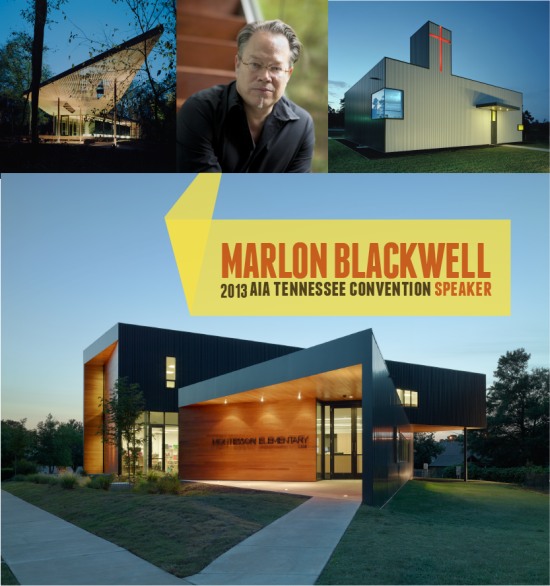
Meet 2013 AIA TN Convention Speaker Marlon Blackwell /
Marlon Blackwell Architect / Fayetteville, AR
Marlon Blackwell, FAIA, is a practicing architect in Fayetteville, Arkansas, and serves as Distinguished Professor and Department Head in the Fay Jones School of Architecture at the University of Arkansas. Work produced in his professional office, Marlon Blackwell Architect, has received national and international recognition with numerous design awards and significant publication in books, architectural journals and magazines. Blackwell received the 2012 Architecture Prize from the American Academy of Arts and Letters. A monograph of his early work, “An Architecture of the Ozarks: The Works of Marlon Blackwell”, was published by Princeton Architectural Press in 2005. He was selected by The International Design Magazine, in 2006, as one of the ID Forty: Undersung Heroes and as an “Emerging Voice” in 1998 by the Architectural League of New York. He received his undergraduate degree from Auburn University (1980) and a M. Arch II degree from Syracuse University in Florence, Italy (1991).
Describe your office culture in general then how it relates to cultivating a strong design process.
Our studio culture is developmental in nature. There’s a lot of latitude. Our office has seven full time staff and everyone is expected to do everything and that gives them the opportunity to experience all phases of a project. They are involved in meetings to have client contact, to learn how to communicate with the client and our project team. My role is more than benevolent leadership. I’m involved in every aspect of each project. Our firm is design oriented, but what distinguishes our process is our engagement of material logics and technology in the front end of conceptual thinking. Common sense and a search for questions direct the process. Throughout the process, we advocate a commitment to economics, and in the spirit of William James, we embrace pragmatism to guide our decision making.
What inspires your design? Where do you find design inspiration?
Day to day experiences of the world as I find it. I’m not a prisoner to one line of thinking. I find inspiration from within the project – its particular place, the building program, the people I meet. I find it in the process, immersion in the project. I find it in the intersection of nature and culture; inspiration is drawn from all aspects of life.
Who is your dream client and why?
The dream client is engaged and involved, proactive and not reactive. They have a deep respect for what we bring to the table and they’re not afraid to offer real fodder for discussion, to have a dialogue through intelligent conversation. The aspirations they have for the project is beyond mere function. They have aspirations for beauty, significance, and contributions to the larger public good. They are as invested and focused in the project as much as you are.
Are there unique ways you engage your client?
We spend time to develop trust with our client. We are attentive and responsive to the client’s input and work on building a personal relationship with them. We don’t always give them what they want but we do give them what they need. We demonstrate to them that the creative process can solve for many challenges at once. In being responsive, we are agile and contingent. The best designers are conceptually agile with the ability to propose designs that resolve four to five things, not just one.
There is the current topic that architecture graduates and young interns are not prepared when they enter the real world or the profession. What have been some key things about the real world and the design profession you’ve learned that you wished you learned early on?
Talent works quickly. Talent makes decisions, doesn’t defer, talent seeks multiple possibilities at multiple scales in non-linear ways. In school, the design process moves too slowly. Ideas must be generated, tested and re-generated quickly without becoming too precious. The manifestation of a good idea can be executed in multiple and varying forms. Students must learn to lose their hold on preciousness. I think students also need to develop a good business sense and learn the basics of how to build a business. Classes for business and entrepreneurship are essential to introduce the principles of selling. This is key to helping someone succeed in our profession. Learn how to sell ideas. The better you can relate to people, the better relationships you build, the more opportunities you create.
Any other advice to young architects or students or those wanting to study architecture?
The one thing I have learned is that very few people who are not in the architecture profession are interested in our fantasies, unless you demonstrate how it’s valuable or useful to them. Architects need to get better at quantifying quality, demonstrating the value of quality.
Those wanting to study architecture must have a passion for it. You must be willing to develop your skills into a disciplined way of working. Skills get you into the union but discipline pays the dues. Reading is also important in understanding the discourse of architecture – where things are going, what questions were important and what questions and issues are important now. Once you understand how this works, then you may understand the importance of being critical, the ability to make commentary on the world. But it is the ability to take commentary and put it into action, to demonstrate how it can work in and on the world in useful ways that is most essential to what we do.
And don’t forget beauty, proportion, and scale! So many issues and concerns in the profession now are often distractions for the making of architecture, in the fullest sense – sustainability, social activism, ethics, project delivery, LEED…the list goes on. What good is it if in the end the work of architecture that embodies these issues is shit? We must be committed to mastering the universal language of our discipline. This is the patient search for true things, the core values that make deeply meaningful work.
The key to developing your own voice, your language and means of expression is to always have a particular set of ideas to continuously work on that operate outside of the projects you are working on in the office. It can be – formal, or urban or material – any ideas that can be studied and developed within projects over time; a singular pursuit that is independent of day to day practice in the delivery of a project. Projects then become vehicles of focus to develop a language of one’s own. Without this focus, architects drift along being directed by circumstance. Passion, ideals, and principles get lost and our development as architects-at-heart becomes stunted. Know what your focus is…seek out friends who share your interests. Get to know them…ask yourself who would I like to go to dinner with? And finally, dare to be influenced by the best.
Organizations like Architecture for Humanity have brought forth the importance of architects and good design in humanitarian efforts. Also, the keynote speaker at this year’s national convention is the founder and CEO of TOMS shoes Blake Mycoskie. Have you been involved in humanitarian projects?
Humanitarian involvement is critical. This type of civic engagement helps one understand how to communicate to a lay audience and make real connections with them. I find architecture students who work on humanitarian projects really invest themselves into it – they are deeply motivated when something is at stake. It demonstrates to them in very tangible direct ways the value of design. It’s very stimulating. Students are more responsive and serious when they are working on things that are larger than themselves. As a rule, our firm is engaged in a pro-bono project every year. We just finished the Northwest Arkansas Free Health Clinic and are now beginning to start work with the NWA Center for Equality to help them generate designs and fundraising material for a new headquarters. These are often organizations with few resources and but need our design expertise to help improve and strengthen their outreach capabilities and facilities. It is our belief that everyone deserves architecture, that architecture can happen anywhere, any scale, and at any budget.
Why do you think this kind of work is important for you or the profession?
As architects and citizens, we should do more. Can we put purpose before profit? The future for architecture is for architects to become more entrepreneurial, to get involved in generating projects, sometimes out of nothing. Do architects want to be leaders or not? One way to be a leader is working on these kinds of projects to instill fundamental civic dignity in our communities.
The theme of this year’s convention is Nowville, a term GQ magazine used recently to describe Nashville, a current city on everyone’s radar as a place to live, play, and work. Nashville like all great cities has a unique character that attracts visitors but also cultivates the life of its residents.
What do you see as important ingredients to a great city?
A great city is made up of great places for people to gather and great infrastructure. It’s made for people and cars… all the messiness involved that needs some kind of thoughtful ordering. That’s where architecture and design come in. A great city also needs progressive and creative thinking at the government level.
What role does the architect need to play in this?
Architects should be actively involved in the community, deeply engaged with the current thinking of the city. We can respond to it or resist it. We need to be vocal, we need to call out bad design and ill-conceived policies. It’s difficult I know to not come off as embittered or in conflict with professional colleagues. Still, we need to find a way to contribute to the city as concerned citizens. The best way I can think of is to make a few damn good buildings and places for your city that people truly care about and that offer alternatives to the numbing conventions that often define the reality of most citizens. We must, as a profession, raise the design expectations of the public.
Describe your impression of Nashville.
Hmm, the last time I was in Nashville was three years ago. First, I think of it more as a big town (that’s a compliment). It has a beautiful setting, though architecturally not particularly memorable. I think of its rich country music history, though I really hate new country music, at least the pop influenced dreck that passes for country these days. To me, the problem is the city is too slicked up (like the music) – I miss George Jones, Minnie Pearl, and Hee Haw. I do know and like that the Kings of Leon (one of my favorite rock ‘n’ roll bands) lives in Nashville. And of course, it is the home of Jack White and Jason and the Scorchers (great 80’s punkabilly band). So the place is an enigma for me; there is something contradictory about it – I want to know the city more.
What are you looking forward to on your visit to Nashville?
Great southern food. Finding the under belly of this place, the seedier parts where a punk sensibility intersects with remnants of the Grand Ole Opry. I want to know what’s emerging from between the city’s cracks. What’s the new legacy for Nashville?
What are you looking forward to in attending the convention?
To see what Frank Harmon will be wearing and what’s in the trunk of Elvis’s Cadillac at the Country Music Hall of Fame.
What’s on your playlist in the office as you work? What music gets you motivated?
Well, I used to be a DJ. On my playlist are bands like The Rolling Stones, the Animals, Kings of Leon, the Ramones and Iggy Pop. Iggy Pop’s “Lust for Life” gets me motivated. I wake up to that song every morning. Other motivating music: Slim Whitman, Notorious BIG, Howlin Wolf, Otis Redding, Dean Martin, and Johnny Cash to name a few. It cuts across all genres: rockabilly, blues, soul, rap, classic Country and REAL rock ‘n’ roll (hard to find these days).
Anything about yourself not many people know that you’d like to share, such as another talent.
I was a very good Bible salesman. I sold bibles door to door for five summers to pay my way through college. I spent a week each summer in Nashville at sales school. We stayed at the old Howard Johnson’s Hotel where the Hee Haw cast would stay while they were filming…crazy times with Junior Samples. I try to fly fish but I’m not so good at it. I don’t really have many other talents except maybe Foosball. Architecture is my primary talent. I do what I do and I focus on doing it well.
///
We look forward to Marlon’s presentation at the AIA TN state convention August 14th.
Read more about him through the link below.
Web: www.marlonblackwell.com
///
Photos courtesy of Marlon Blackwell Architect. Architectural photos by Timothy Hursley. |